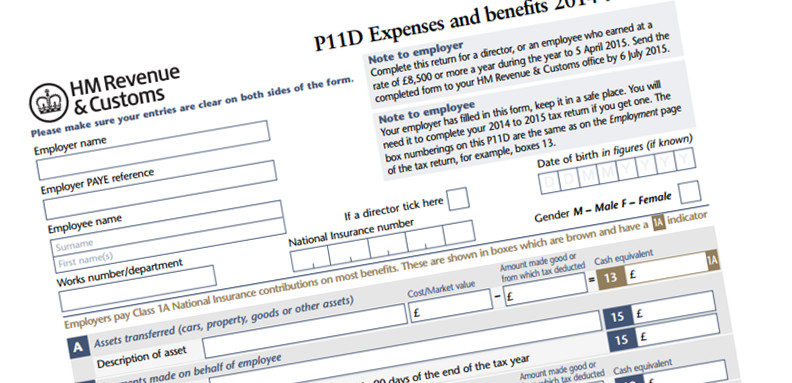
A P11D is a form used by employers in the UK to report taxable benefits and expenses provided to employees and directors during the tax year. These are often called “benefits in kind” or “BIKs”.
What is a P11D?
A benefit in kind is something an employee receives from their employer in addition to their salary. Even though the employee may not receive cash directly, HMRC still treats many of these benefits as taxable.
Common examples include:
- Company cars
- Private medical insurance
- Interest-free loans
- Fuel for private use
- Living accommodation
- Gym memberships
- Non-business travel expenses
- Assets transferred to employees
- Certain subscriptions and professional fees
The employer reports these benefits to HMRC after the end of the tax year using form P11D. HMRC then uses this information to calculate any tax due from the employee and any National Insurance due from the employer.
Official HMRC guidance on P11Ds can be found here:
A separate P11D must usually be completed for each employee or director who has received taxable benefits.
What needs to be reported on a P11D?
Not every expense or benefit needs to be included. Some items are exempt, and others may already be processed through payroll using “payrolling benefits”.
However, the following are among the most commonly reported items:
Company Cars and Fuel
If an employee has a company car available for private use, this is usually taxable and must be reported. Private fuel paid for by the employer is also taxable separately.
The taxable value depends on:
- The car’s list price
- CO₂ emissions
- Fuel type
- Availability during the year
Electric vehicles often attract lower benefit-in-kind percentages than petrol or diesel vehicles.
Private Medical Insurance
Private healthcare or medical insurance paid by the employer is normally taxable and must be reported on the employee’s P11D. This is one of the most common benefits reported by employers.
Beneficial Loans
Loans to employees or directors may need to be reported if:
- No interest is charged, or
- Interest is charged below HMRC’s official rate
This commonly applies to director’s loans or season ticket loans. Small loans below the exemption threshold may not need reporting.
Living Accommodation
Accommodation provided by the employer can create a taxable benefit, especially where it is not necessary for the employee’s role.
Expenses Paid on Behalf of Employees
Expenses reimbursed to employees may need reporting if they are not wholly business related or are not exempt. Examples can include:
- Non-business travel
- Hotel and subsistence costs
- Entertainment expenses
Assets and Services
Benefits can also arise where employers provide:
- Mobile phones beyond exempt limits
- Gym memberships
- Assets transferred to employees
- Goods or services at reduced cost
Vouchers and Credit Cards
Employer-provided vouchers and company credit card spending may also need reporting where taxable.
What does not usually need reporting?
Some items are exempt and normally do not appear on a P11D, including:
- Business travel expenses meeting HMRC rules
- One mobile phone per employee
- Workplace parking
- Trivial benefits within HMRC limits
- Benefits already taxed through payroll
- Items covered by a PAYE Settlement Agreement (PSA)
Important Deadlines
The UK tax year runs from 6 April to 5 April.
Key P11D deadlines are:
| Deadline | Requirement |
| 6 July | Submit P11D and P11D(b) to HMRC |
| 6 July | Provide employees with a copy of their P11D |
| 22 July | Pay Class 1A National Insurance electronically |
Paper filing is generally no longer accepted except in limited circumstances. P11Ds are now normally filed online.
Late filing or incorrect returns can result in penalties and interest from HMRC.
What is Class 1A National Insurance?
Class 1A National Insurance Contributions (NIC) are employer-only National Insurance charges paid on most taxable benefits in kind.
Employees generally pay income tax on the benefit, while employers pay Class 1A NIC.
For example:
- An employee receives private medical insurance worth £1,000
- The employee pays income tax on the £1,000 benefit
- The employer also pays Class 1A NIC on that £1,000
Class 1A NIC is reported using form P11D(b), which summarises the total taxable benefits provided during the year.
The rate of Class 1A NIC normally matches the employer’s National Insurance rate for the relevant tax year.
Payrolling Benefits
Many employers now choose to “payroll” benefits instead of reporting them later on a P11D. This means the tax on the benefit is collected through payroll during the year rather than through a tax code adjustment later.
Even where benefits are payrolled, employers may still need to submit a P11D(b) to declare the Class 1A NIC due.
Further Guidance
For detailed technical guidance from HMRC, see:
- HMRC P11D and P11D(b) guidance
- HMRC guidance on completing P11D forms
- HMRC PAYE end of year expenses and benefits guide